Over the three months ending April 2026, the median sale price in Bernal Heights fell 3.9 percent year over year to $1.6 million. In that same window, the median price per square foot rose 10.7 percent to roughly $1,120. Read those two numbers side by side and they look like a contradiction. A neighborhood can't be getting cheaper and more expensive at the same time.
Except it can, if what's actually selling has changed shape. Anyone who has priced a listing on this hill already knows Bernal isn't one market. It's two, split by which slope a house sits on and what its retaining wall history says.
A Hill Built on Its Own Support System
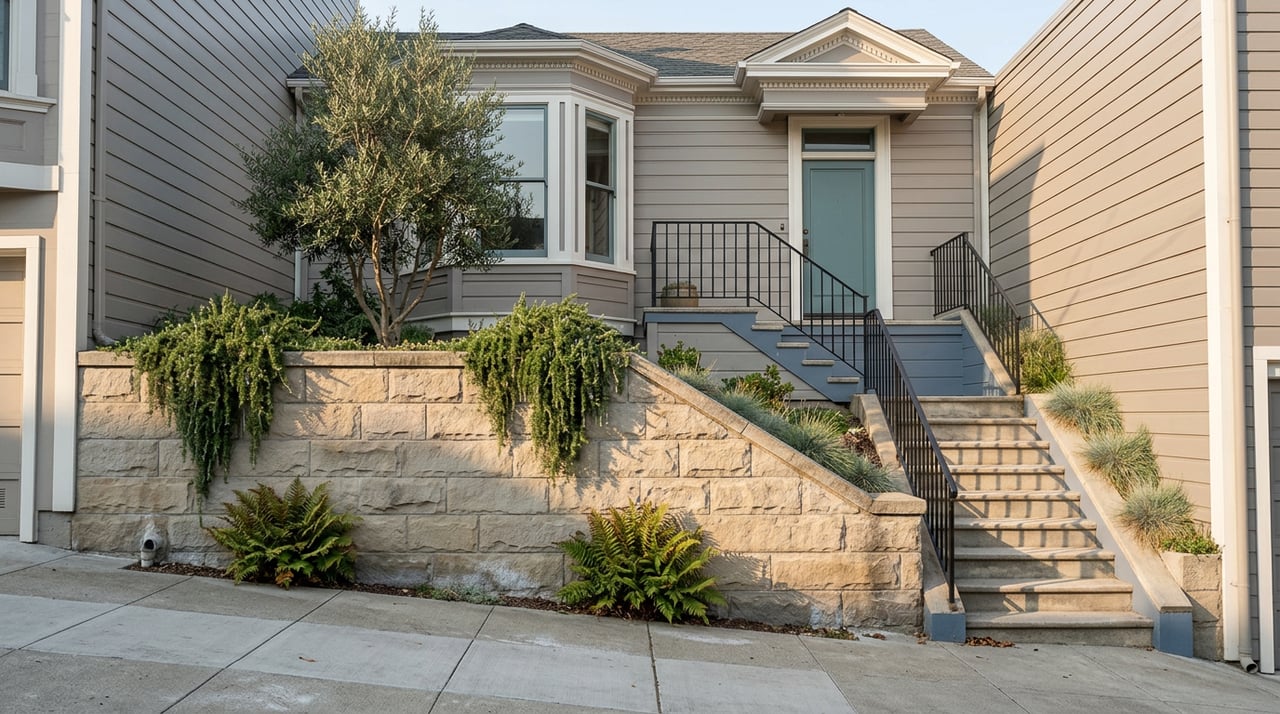
Bernal Heights Park sits at the summit, and the streets fall away from it in three directions that locals still refer to by name: the north slope, the south slope, and the west slope. Most homes here sit on 25-foot-wide lots, attached to their neighbors, which is part of why fully detached houses are considered a rare find in this part of San Francisco. North-facing homes tend to look toward downtown. The east-facing stretch of the south slope looks out over the Bay. None of that geography is flat, and none of it stays put without help. On a hill like this, a retaining wall isn't an amenity. It's load-bearing infrastructure that happens to sit outside.
The neighborhood's older, more granular names still get used the way locals talk about it: Cortlandia around the commercial heart of Cortland Avenue, Precita Park to the north, Holly Park and St. Mary's Park toward the west and south. Each pocket has its own grade, its own drainage pattern, and its own history of what's been built to hold the ground in place.
The Line Every Bernal Disclosure Answers First
San Francisco's standard seller disclosure form has a lot of yes-or-no questions on it, but one carries more weight than its length suggests on a hillside neighborhood like this: are there any problems with retaining walls, such as leaning, bulging or cracking? On a flat lot, that question is almost an afterthought. On a Bernal lot, the answer touches the foundation, the yard, sometimes the neighbor's yard too.
The city treats this seriously enough to write it into zoning. Section 242 of the Planning Code, which governs the Bernal Heights Special Use District, calls out the Bernal South Slope by name and requires new development there to follow best practices for construction on steep grades, specifically citing liquefaction and slope stability as documented concerns. That's not generic hillside language borrowed from somewhere else in the code. It's written for this specific stretch of the city, which tells you the risk profile here isn't theoretical to the people who regulate it.
What "Yes" Actually Requires
Once a wall has any history, disclosure stops being a single checkbox and becomes a documentation exercise. In practice, buyers and their agents expect to see a fuller packet:
- The Transfer Disclosure Statement plus a Seller Property Questionnaire with narrative detail on what happened and when
- Engineering reports documenting any past movement and the recommended scope of repair
- Permit records and contractor invoices tied to the wall itself
- Dated photos of cracks, drainage patterns, or prior repair work
- Any past insurance claims or construction-defect disputes, if they exist
The permit thresholds themselves explain why "small" walls aren't automatically simple. In San Francisco, a retaining wall under 3 feet generally doesn't need a permit unless it's holding back a driveway or another load. Between 3 and 6 feet, it needs a permit and engineered drawings. Above 6 feet, the Department of Building Inspection's Structural Engineering Section gets involved, along with additional geotechnical review. A wall's permit history, or the absence of one, becomes part of what a buyer's team is quietly checking before an offer goes in.
None of this is optional paperwork a seller can wave off with an as-is sale. California's disclosure law requires sellers to describe known material defects on the Transfer Disclosure Statement regardless of how the sale is structured, and that duty extends to the listing agent, who is expected to flag observable issues like a visible crack in a stem wall even if nobody brings it up first. That standard has been part of California real estate practice for decades, and it still shapes how disclosure packets get built today.
Reading the Median Correctly
Here's where the two headline numbers stop contradicting each other and start making sense together.
| Metric | Three months ending April 2026 |
|---|---|
| Median sale price | $1.6M, down 3.9% year over year |
| Median price per square foot | About $1,120, up 10.7% year over year |
| Median days on market | 14 |
| Homes sold in April | 60, up from 54 a year earlier |
A rising price-per-square-foot alongside a falling median usually means the mix of what's transacting has shifted, not that the neighborhood broadly lost value. In Bernal, that shift tracks closely with slope and disclosure history. Homes with clean retaining wall records, recent engineering signoffs, or simply a lot configuration that never raised the question in the first place are drawing strong competition on a per-foot basis and moving in roughly two weeks. Homes carrying an open question about wall condition, or larger properties on the steeper faces where remediation is a live possibility, are pricing lower to account for what a buyer will have to spend finding out the rest of the story.
That's not a neighborhood in decline. That's a neighborhood pricing information. The homes with the clearest paper trail are commanding a premium per square foot precisely because the buyer isn't taking on unknowns. The homes without that paper trail, or with a documented but unresolved issue, are settling into the lower end of the median, which pulls the overall number down even as the top of the market holds firm.
If You're Selling on the Slope
The sellers who do best here treat the disclosure conversation as prep work, not a surprise to manage during escrow. If there's any known history with a retaining wall, getting an engineering evaluation and gathering permit records before the home goes on the market means the paperwork is ready the moment a buyer's agent asks, rather than assembled under pressure with an offer deadline looming. A documented and resolved repair reads very differently to a buyer than an open, undisclosed question. One is a closed chapter. The other invites a longer inspection period and a lower number.
If You're Buying on the Slope
The flip side matters just as much. Ask about slope position and wall history early, before falling in love with the view. If any wall on the property is over 3 feet, request the permit record for it specifically. A documented repair with an engineering signoff isn't automatically a red flag. It can actually be reassuring, since it means someone already paid to find out what the ground was doing. What deserves more scrutiny is silence on a question the disclosure form asks directly, especially on a lot where the grade makes the question unavoidable.
Does a documented repair history hurt resale in Bernal Heights? Not inherently. A resolved issue with an engineering report and permit trail tends to read as due diligence completed, which is different from active, unresolved movement.
Do all Bernal Heights homes have retaining walls? No, but grade change is common enough across the north, south, and west slopes that the disclosure question comes up on most hillside listings, even when the answer ends up being straightforward.
Bernal Heights rewards buyers and sellers who treat the hill itself as part of the transaction, not a backdrop to it. Understanding what a slope actually costs and what it protects is the difference between a smooth escrow and a surprise one.
If you're weighing a purchase or a listing on Bernal's slopes and want a clear read on what a specific property's terrain and disclosure history actually mean for pricing, Suzy Reily can walk through it with you. Let's Connect.